

Last week, I closed two half spays and felt like a god. Perfect knots, even spacing, no glue needed. Even the supervising veterinarian, who’s done thousands of spay and neuter surgeries in her career as a shelter vet, told me my close was better than hers. My internal monologue was basically “yippee yay” on loop for the rest of the day. I treated myself to a salmon poke bowl and taro bubble tea, then spent a very happy weekend thrift-shopping.
This week, during my first full spay, the loop had changed to “shit shit shit.”
I took two hours for the surgery itself. TWO HOURS, for something I’d told myself would take one, at this stage of my career.
Let me get this out first: I LOVE SURGERY. So so much. I’ve always felt confident in my hand-eye coordination (thanks to years of piano) and confident that I could repeat “sewing patterns” enough times to troubleshoot almost anything with my hands. Turns out I’d just been shielded from the actual horrors that could have happened.

Today wasn’t much of a horror story. Nothing actively bled, and I didn’t drop anything. But I can’t promise myself that won’t happen eventually, because even the best surgeons I know have poked into a spleen, or had something go sideways in the room they didn’t see coming.
Still, I knew exactly when my confidence left the building. It was the opening, the part I thought would be the easier one. I’d spent most of my half spays at my externship clinic practicing closing, and by now I trusted myself with that skill completely. So I figured I was good. Little did I know how much “trouble” needed to be “shot” during the first half of the spay.
The first half hour was just for getting through the abdominal wall, a step that should have taken five minutes. I was cutting into it like carving wood, terrified I’d nick something I shouldn’t. And I hadn’t predicted how much the subcutaneous layer would get me. Undermining that layer with Metzenbaum scissors felt like peeling an orange where you only get little bits at a time. By the time I reached the pedicles, I already had tension sitting in my shoulders and neck.
Then the pedicles, the stupidly annoyingly adhered pedicles. I was afraid of yanking too hard, of losing them, but they were awfully stubborn. The first pedicle was not the worst, took me 15 minutes. The second pedicle was lost and twisted and tucked under the never-ending intestinal loops. I burned a stupid amount of time panicking before finally settling down enough to problem-solve.
It’s a strange thing, knowing the structure is right there, somewhere inside the abdomen you’re already standing in, and still not being able to find it. My hands kept doing the same motion, sweeping the same spot, as if repeating it would make the pedicle materialize. It didn’t. What finally helped was stopping, breathing, and actually thinking through my options instead of just digging. Turns out there’s more than one way to hunt down a pedicle when it’s hiding on you.
Here are the tips I learned, in case it might help you too:
Extend the incision. I tried to keep it as small as possible, just as bold as when I was thinking the surgery would take under an hour. Next time, bite your ego and make it bigger.
Trace from the side you’ve already ligated. If you already found and secured one side, follow that same structure across to locate the other.
Mirror the technique, and take the second side up the same way you took up the first.
Try a spay hook, in theory. I’m not there yet. Something about a blind hook near soft tissue sends my brain straight to worst-case scenario: the kind that starts with spleen and ends with pools of blood.
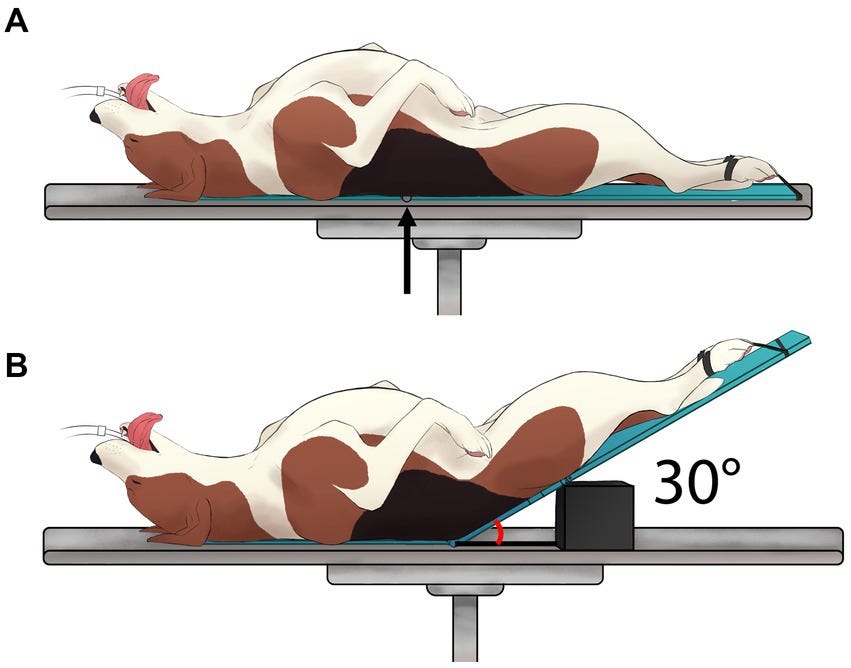
Have someone carefully, and as aseptically as possible, lift the pelvis from under the drape (Trendelenburg position, if you want to sound fancy and medically accurate; in the room, just say butt up, please). This should decrease tension so the pedicle sits closer to your hand instead of retreating into the abdomen like it’s your ex with an avoidant attachment style. This method helped me today.
ONLY WHEN NOTHING ELSE WORKS: Exteriorize some intestinal contents onto the sterile field. This is a controversial technique, but I did this today since nothing else above worked. Have someone keep them moist with warm LRS, and trace the uterine horns from there until you find what you’re looking for. Be gentle with the guts, and be quick, so they’re not out too long.
“You do whatever helps you sleep better at night,” one of my mentors told me. I love that energy, but it might not work for an anxious bean like me. I did all the extra stuff, and thoughts about this spay still loomed over me. Will my little patient be okay? What if she comes back with dehiscence, or septic peritonitis? My mind ran at a speed best measured in bird-heart-rate-in-an-exam-room per hour, cycling through every possible complication. To ease my mind, I thought of her recovery. She was bright and tail-wagging to see me, and even happier (more like ravenous) to receive some treats after.
I keep thinking about the gap between last week’s confidence and this week’s spiral, how fast it flipped, and how little it seems to have to do with actual skill. Maybe that’s just what this year is. Not a straight line from bad to good, but something closer to weather these days: some days clear, some days rainy, and some days you’re cursing your way through a linea alba that should’ve taken only five minutes.
I performed a full spay today by myself. It’s still something worth celebrating. Yet I also have no idea if I’ll feel like “yippee yay” or “shit shit shit” the next time I pick up a scalpel. At this point, I’m trying to be okay with not knowing.
Look, you just removed an entire organ system under the bladder and intestines and kidneys. That's a common surgery, it's not an easy surgery. Anxiety about it is entirely appropriate.
Congrats, doc.
I have read and smiled on entire article. Love the story babe :-)