

In university, I would spend half an hour of free time just watching squirrels. I’d sit patiently on the grass, watching their fluffy tails leap from branch to branch, straining my ears to catch the sound of them gnawing seeds. Sometimes I’d laugh at a gray squirrel chasing a black one. And very rarely, I got to see a red squirrel, and it would feel like finding a bag of gold in the woods. It all made me wonder, are these even the same species, just different colors? If so, why do they fight? I later read that in the UK, Eastern North American gray squirrels are actually invasive, driving down the population of native red squirrels through competing and spreading squirrel pox (this has been an ongoing issue). Even squirrels have their petty conflicts that push their own kind toward extinction. Not yet an issue in Canada, hopefully?
It wasn’t just squirrels; I loved spotting birds in the wild too. My best friend in university was an avid birder. She would wake up early every weekend, bring her binoculars to a nearby trail, and watch birds for hours. She knew so many species, some just by the sound of their calls alone. Katherine showed me the beauty of birds. She opened my eyes to a world far beyond the pigeons and sparrows, the only two species I’d ever known growing up in Viet Nam.
Curiosity, it was. Of the beauty and the majesty of animals. How different they are made, yet how fully alive they all are, going about their business, unaware of the circle of life pressing in around them. I mean, who am I to say I understand it better than they do? But curiosity, at least on the surface, was what drew me to animals.
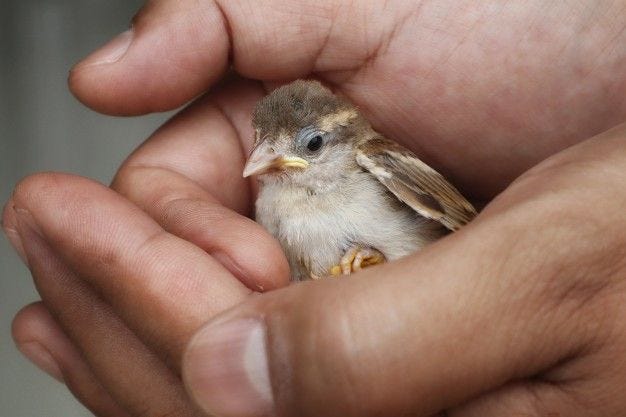
One time, a sparrow flew into our backyard in Viet Nam. Our backyard had two big cây cau (betel nut palm trees), so animals often found refuge there. A bat once took a nap on the large leaves and accidentally flew into our house. But this time, a little sparrow had fallen from somewhere and couldn’t walk, couldn’t fly. Had it tumbled from a nest? I couldn’t find one, but I was in Grade 2, probably three-four feet tall, and the trees were more than quadruple the height of Victor Wembanyama.
My maternal grandmother carried the bird inside, and I remember freaking out: What if it dies? How do we take care of something this tiny? Grandma dropped a bit of sugar water onto the bird’s beak to check its response. It was conscious, just not flying. We sat with it for about half an hour, not knowing whether it would get better. But it did fly away, after all. Maybe it was just shocked after hitting the walls or something.
(Warning: the next section contains animal death and some graphic details. Please skip ahead to the next line break if you’d prefer.)
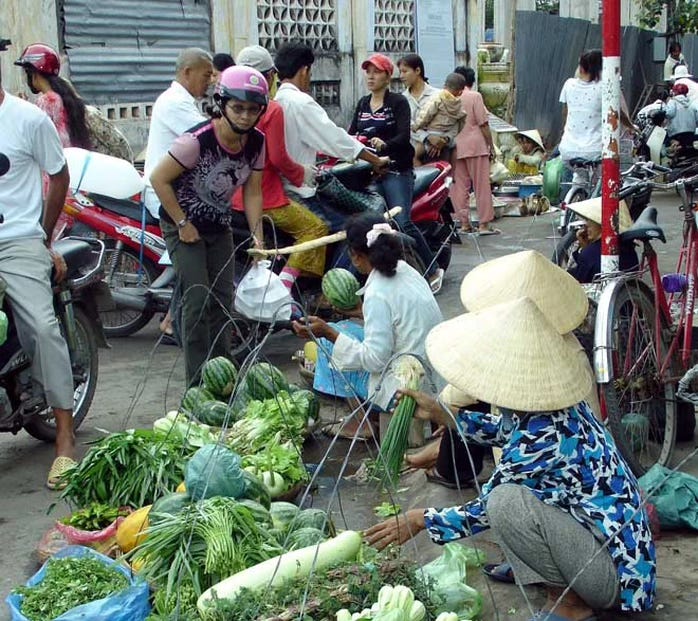
Another time, I think I was seven. I was on the back of my other grandmother’s motorbike in a narrow market alley, the kind so thin only a single car could pass through. Vendors pressed in on both sides, calling out prices and haggling with customers. We had stopped briefly to pick up vegetables for dinner. As I looked out at the busy alley, I noticed a tiny kitten on the road. It was so small. I felt connected to it; I was a tiny kid too, after all.
Then, very suddenly, a motorbike shot through the alley.
When I looked again, the kitten was still on the road. Blood was spurting from its tiny head. Its cries thin and unceasing. I froze. My grandmother, unaware of what had happened, drove us away.
I have travelled back to that moment, on and off, for years, and never once left it feeling lighter. What if I had told her to stop? What if we had scooped the kitten up and rushed it to the vet somewhere? Would it have survived? Would she have allowed it, or waved it off as just an animal, a lesser life form not worth the trouble? I’ll never know. My fear got in the way of potentially helping that little one, and I’ve carried that regret ever since. It doesn’t get talked about enough: how in certain places and cultures, animal lives are not seen as precious, but as something lesser. A life not worth considering.
I have recurring nightmares about not being able to save an animal. Sometimes it’s that kitten; the image of its suffering still burned into my mind. Sometimes it’s a squirrel seizing on the pavement; I pick it up, helpless, not knowing what to do. Sometimes it is my own cat. I dream she has cancer I can’t cure.
It is, truly, my absolute worst fear: to stand in front of a suffering creature and have nothing to offer.
Perhaps that fear, more than anything else, is what drives me to become a vet. Not just curiosity. Not just love. I want to learn and be trained so that when I see an animal suffer, I don’t freeze. So I can do something to end its suffering; either help heal it, or help it leave pain behind with more peace than that kitten in the alley had.
“It’s time,” it says. “That being’s life and death belongs to me, not yours to carry.”
I know this is something I will struggle with, and will have to make peace with at some point. Because sometimes, even when you have given everything you have, even when you have tried your absolute f*cking best—you still can’t save them. And that’s just the universe moving in its wondrous, mysterious way. “It’s time,” it says. “That being’s life and death belongs to me, not yours to carry.”
Is that a healthy mindset, or just a coping mechanism? I honestly don’t know.
Cancer isn’t solved yet. Neither is human ego, nor our stubborn inability to let go of what we cannot control. But I need to keep reminding myself: I’m here to help in the best way I can, not to rewrite the fate already written in the stars.
Beautiful article, thank you for sharing. Squirrel-watching is also a passtime for my family, despite the fact they steal all the bird food!
this made me cry. i know you will be a great vet and save so many innocent souls. more power to you!